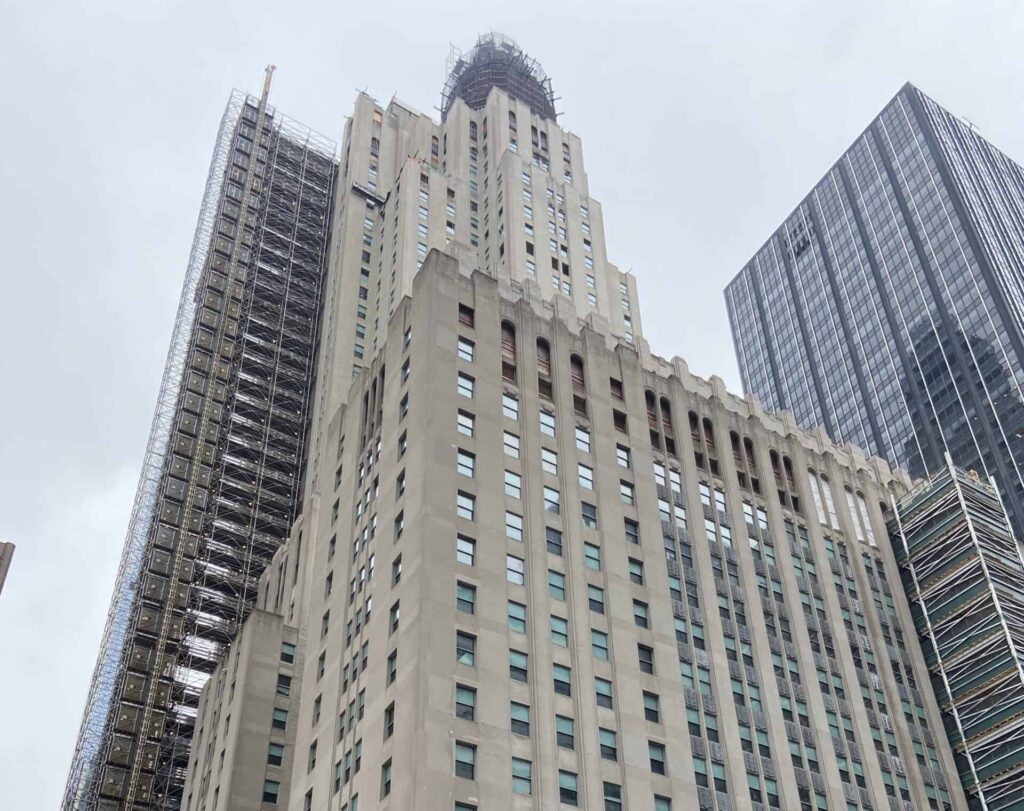
Waldorf Astoria New York

The iconic Waldorf Astoria New York reopened to guests and residents in 2025 after a signature modernization project.
AKRF provided air quality, civil engineering, and vibration monitoring services for restoration of the Waldorf Astoria New York, a New York City Individual and Interior Landmark, and its transformation into 372 condominium residences atop a redesigned 375-key hotel.
Photo by Dave Burk @ SOM
Industry Honors
2026 MASterworks Design Award
Air Quality
The air quality analysis and permitting was performed in accordance with New York City Department of Environmental Protection and New York State Department of Environmental Conservation requirements.
AKRF provided guidance to the design team for a proposed 555 kilowatt (kW) combined heating and power plant with regard to the location of the exhaust stack and emissions controls to ensure there would be no potential significant adverse air quality impact.
We also prepared an environmental assessment to demonstrate the proposed combined heating and power plant would not result in significant adverse impacts pursuant to City Environmental Quality Review guidelines.
Civil Engineering
Our civil engineering responsibilities included drive court design, Builders Pavement Plans, and associated agency reviews and approvals.
Vibration Monitoring
AKRF monitored vibration levels at landmark areas within the Waldorf Astoria New York during interior construction in accordance with New York City Department of Buildings regulations. We worked with the construction manager to develop the monitoring program and secured vibration transducers to the monitored surfaces using sandbags rather than bolts to avoid damaging the landmarked interior finishes.
Our vibration monitoring equipment recorded data while unattended throughout construction activity and sent “vibration limit exceedance alerts” via email/text message when measured vibration levels exceeded the project’s maximum allowable criteria.
This allowed the construction team to understand exactly where and when construction was producing levels of concern so that means and methods could be re-evaluated before any damage occurred.